





So I admit, this is one topic that I struggle with. I'm a screen shot kind of writer - I see scenes play out in my head just as if it were a movie going on up there. I've spent hours with my eyes closed, just thinking of the day to day stuff my characters encounter. I see their facial expressions, I hear the tone of their voices, and I feel like I'm right there with them. Don't my readers want to see this stuff too, I ask? Unfortunately the answer isn't always yes.
So how to decide which scenes to cut and which to keep? The short answer I always hear is that if a scene doesn't move your story along then it can be cut. Now this doesn't necessarily mean that it has to be cut, just that it can be. And making such a decision is not always easy. One thing that was helpful to me in my first round of revisions was to make an Excel spreadsheet. In it, I made columns for each scene and briefly described what that scene was about. While I had columns for other things, like notes on how to improve the scene or what emotion I wanted to get across, I also had a very important column labeled "purpose". There can be many purposes to a scene, but each should have the end effect of moving the story forward. If it doesn't or if you come up blank with finding a good purpose for having the scene then you might want to consider cutting it.
Some examples of purpose I had in my spreadsheet:
1. Instigating event - the instigating event is what launches the story. For NW this happens in the first scene when Sam jumps off the tower. Identifying your instigating event is important for deciding where to start your story. If it occurs much later than chapter 3 or so, then there's a chance that you're not starting in the right place. It can also be a sign that you're giving too much backstory too early.
2. Introduction of antagonist- this is very crucial for my story, but what if you don't have a villain? Well, sometimes the antagonist is the main character herself - an inner antagonist if you will. Scenes which show a person's inner struggle are very good for moving the story forward. But be careful you don't over do it by showing a number of instances that show the same thing just for the sake of driving in your point. For instance, you might want your reader to know that your main character struggles with insecurity - this could be her inner antagonist. But you don't want to show her getting cold feet in front of a crowd and then not talking to a boy and then having a hard time telling her friend that she's a bitch. Unless each of these events is critical to how the story unfolds, then it may not be necessary to show each one. Pick one that is the strongest and make that scene memorable.
3. introduction of the MC's conflict with another central character. This happened several times in NW - first when I introduce her parents and then again when I introduce Seth, her ex-boyfriend. In each instance I was basically laying the groundwork for subplots, so they were important for me, but what if you're not introducing subplots? Do you have to show your main character talking to her parents if they're not important in the story? Do you have to show interactions with all your MC's exes if they're never mentioned again? Here again, we're defining a purpose and while your purpose might be to introduce a character, it might be that the character isn't all that necessary to the plot in which case cutting a scene may be analogous to cutting a character.
4. Showing how the main character has changed - in other words, how the character has developed. Going back to our example of insecurity being an inner-antagonist, you might have a scene where the MC suddenly gathers the courage to talk to that boy. This would obviously be an important scene for your story. This sort of purpose usually happens toward the ending. If it's happening too soon then it's possible you're not pacing your character's inner changes very well. You don't want to resolve a major conflict way before you get to the ending.
5. mid-point reversal - I'd never heard this term before reading Janice Hardy's blog and here's a great refresher on what exactly it means. In Janice's words, it's like a mini-climax in the story that illustrates what the main character is willing to do to win or to show what's most important to them at a basic level. It's usually something unexpected that surprises the reader or even raises the stakes or tension higher. I know exactly where my mid-point reversal is in NW even though I didn't think of it that way when I wrote it. It was basically me throwing a wrench into Nikki's plans and she spends most of the rest of the story finding a way around it. I was also surprised to find out that my other WIP, Bettina, also has a mid-point reversal and again I didn't think of it that way at all when I wrote it. See if you can pick out a midpoint reversal in your own story. If you can't find one, then consider whether the middle of your story is dragging and if you need something like this to move your story along.
7. to show the MC doing something to solve her problem. In NW, Nikki has a major problem she has to solve and she has to do some sleuthing. I have a couple of these scenes. Is each one critical? No, and I've tweaked some back and forth shortening here and lengthening there where appropriate. This is one area where my spreadsheet has been particularly helpful.
8. Backstory - the dreaded purpose. We all need to incorporate backstory at some point, but devoting entire chapters to it can be deadly, especially if this happens early in the story. I try very hard to sprinkle it in here and there. The first 50 pages of NW has very little of Nikki's backstory. The only thing we learn about her is that her sister has died. This is a very critical event in her life and the central theme of the story, but that IS ALL that is mentioned about it. The place where I do have an entire chapter devoted to backstory is when Sam tells Nikki about his life before he met her. It happens about a third of the way through and was very hard to get around. One of my recent revisions was to take Sam's story and make it more active - I can do this quite easily because Sam is a genie (holograms are easy to conjure). But if you have a chapter devoted entirely to backstory think of how you can change it to make it more engaging. Can you add more voice? Can you entwine it with another event in the story so that you're not bombarding the reader all at once? Consider also if it's necessary that the reader know this RIGHT NOW. It's often the case that backstory isn't needed at the time it's presented and can be saved for later or broken up into pieces.
After writing this post, I realized that a lot of what I wrote here also relates to pacing. I'm not a strict outliner nor am I a pantser. I do a combination of both. If you're a panstser or like me, once you have that first draft written it might help to make a spreadsheet like this or an outline. It can help you define what needs to go, what needs to be added and what needs to be shuffled around. What's more is that you can look at each element critically and decide if every purpose has equal weight. Were you making up purposes for a scene just because you want to have an excuse for it to be there? Were there multiple times when you had the same purpose, and can you justify having multiple chapters devoted to the same purpose? And remember, even if you can't justify having a scene that doesn't necessarily mean that you have to remove it. I've had a few scenes that really didn't need to be there, but they were just plain fun. When I suggested taking these scenes out to my betas, they screamed no! So, if you're in doubt always go with your gut instinct - or you know, get that second opinion. Beta readers are worth their weight in gold.
Recent Posts
Showing posts with label revisions. Show all posts
Showing posts with label revisions. Show all posts
Thursday, October 7, 2010


Wednesday, October 6, 2010
Guest post - Janice Hardy author of Blue Fire - The Healing Wars Book II
Today we have guest blogger, Janice Hardy, with us to talk about her process of revising and editing. I first came across Janice on the AW forums and subsequently visited her blog. Her first book in the Healing Wars trilogy, The Shifter, is a great MG read and now her second book Blue Fire is out as well. I can't wait to get my hands on it! I've learned so much from Janice, and I encourage everyone to check out her blog and the tour she's doing over the next month - there are links on her blog. So without further ado, take it away Janice!!
 Edits vs. Revisions: One on One Death Match
Edits vs. Revisions: One on One Death MatchYou often hear edit and revise used interchangeably, but they really are two different things. Editing is the nitpicky, line by line tweaks that polish your text. Revision is more macro level, changing parts of the story. But how do you know when to use one over the other? I revise first, because that covers the big issues. The things that may take a lot of work. Once the story is unfolding how I want, then I edit, polishing it until it shines.
Macro Issues
I like to work from the top down, tackling the largest “problem” first, since odds are that will change other things. There’s no need to polish the text of a paragraph if you might cut that entire scene.
Story & Structure
This is the biggest part of any novel. If these aren’t working, none of the edits you make will do any good. Take a step back and look at your overall story. Is it working? Things may need to be changed, so don’t worry about the smaller “this part is too slow” problems. Does the basic story work and unfold in a way that makes sense? Is the structure working? Do you need more set up and less middle? A longer ending and shorter beginning? Are there too many chapters? Too few? Do you need to break in into parts?
Plot & Stakes
Now look at the plot. Does each plot event advance that story in a logical way? Are there too many subplots? Too few? Check your stakes. Are things going from bad to worse over the course of the novel? Are the stakes worth risking something for?
Characters & POV
Do you have the right characters? Is the protag the best person to tell this tale? Is the antag the right bad guy? Are the secondary characters pulling their weight or are they just hanging around? Are there too many characters? Not enough? Is it told through the right point of view? Are there too many or too few of them?
Medium Issues
Once you’ve revised the major pieces, you can get closer and start tweaking the gears of the story. The guts that make it work.
Pacing
How does your story unfold? Look for those slow spots, the too-fast spots, the jerky spots where the flow feels off. Is there a rise and fall? Does the story feel like it’s moving forward or running around in circles? Are revelations and set pieces happening in the right spots or are they all clumped together?
Scenes & Goals
Check each scene for the POV’s goal, how they plan to get that goal, and what’s at risk if they fail. Do they have a solid goal? (remember, goals can crossover scenes, so they can have the same goal if it takes them a while to resolve it) Is the risk big enough to make the reader worry if they fail? Is the obstacle in their way tough enough so it doesn’t feel like “stuff” just to fill up the story? Does each scene lead logically to the next? Does every scene need to be there? Do you need to add any scenes?
Transitions
Look at your chapter and scene transitions. The right pieces can be in the right places, but how you move from one to the other determines how much the reader wants to follow you. Do you end a scene or chapter with a carrot to lure the reader to the next scene? Do you start the next scene with a new problem without resolving (even if that means “we need to worry about this later”) the last problem? Exciting enders that don’t lead anywhere get old fast, and stop being exciting once the reader figures out you’re just tricking them.
Character Growth & Story Arcs
I put these together because they often go hand in hand. Look at the story arcs for each character. Does their tale unfold in a way that allows them to grow as a character (even small growth)? Are they learning the things they need to learn for the story? Is there a good mix of character arc revelations and story arc revelations?
Micro Issues
By now, the big stuff is done, the story is in good shape structurally, and you’re ready to start the detail work. It’s time to actually edit vs revise.
Dialogue
This is one of the first places I look when I start polishing, because a lot of the other editing issues can be found here. People talking usually pinpoints the story’s “action” (as in, things happening) so they’re also good spots to weave in all the stuff that can slow a story down (but in a way that doesn’t slow it down). Bits of description, backstory, stage direction. These things slip in easier when combined with stuff going on. Is there are unnecessary dialog? Do I have too many tags? Not enough? Can those tags be changed to show action, internalization, setting, etc?
Descriptions
Is there too much? Too little? Is it in the right place? Look for large blocks of paragraphs on the page. Often those blocks are red flags that there’s too much of something going on.
Word Usage
Set off on that adverb hunt, check your prepositions and your classic telling flags, like to, with, saw, looked, etc. Also check for commonly misused words. It is that or who? Effect or affect? Are you using the best word for what you’re trying to say? Often isn’t the same as usually, red isn’t the same as scarlet. What about favorite words? I always have to do a search for just, only, and still.
Rhythm & Flow
How your sentences run together goes a long way to pulling your reader through a story. Are your sentences varied and working with your pacing? Are there too many short choppy sentences in a row? Too many long ones? Does it read awkwardly anywhere? Do you stumble over words or passages? Reading your work out loud can really show you where the stumbling blocks are.
How you choose to work on your novel is up to you, but I’ve found putting myself in the right mindset helps keep me focused on what I’m trying to do. If I’m “revising,” I’m more open to hacking out parts or moving things around, because the text isn’t finished yet. But when I’m “editing,” I’m looking at the individual sentences and not the bigger picture as much. I’m trying to make what’s there the best it can be, not deciding if it should be there at all.
A subtle shift in thought, but sometimes that’s all you need to get the job done.
Blue Fire Blurb
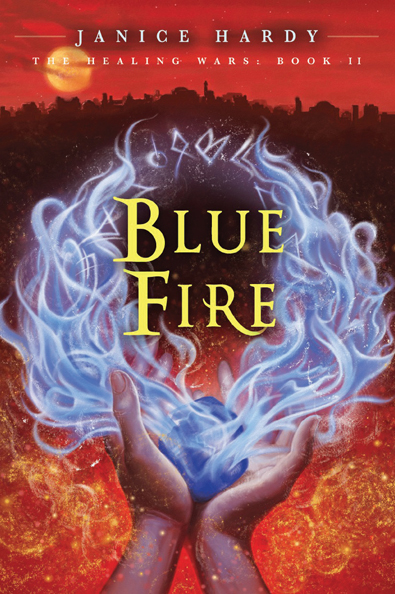
Nya finds herself trapped in the last place she ever wanted to be, forced to trust the last people she ever thought she could. More is at stake than just the people of Geveg, and the closer she gets to uncovering the Duke’s plan, the more she discovers how critical she is to his victory. To save Geveg, she just might have to save Baseer—if she doesn’t destroy it first.
Janice Hardy Bio
A long-time fantasy reader, Janice Hardy always wondered about the darker side of healing. For her fantasy trilogy THE HEALING WARS, she tapped into her own dark side to create a world where healing was dangerous, and those with the best intentions often made the worst choices. Her books include THE SHIFTER, and BLUE FIRE from Balzer+Bray/Harper Collins. She lives in Georgia with her husband, three cats and one very nervous freshwater eel.
Link to Blue Fire Online Retailers
Website
The Other Side of the Story Blog
Tuesday, October 5, 2010
When to delete a character
As promised, today I'm going to talk about the gut wrenching decision to delete a character. This can often feel much more traumatic than cutting a favorite scene. It usually involves cutting more than one scene, and rearranging smaller or perhaps even bigger parts of other scenes. Also we grow fond of our characters, they become like real people and cutting them can often feel like issuing a death sentence. In short, it's not a decision to be taken lightly. Except when it is.
What do I mean by this? Well consider, if cutting a character has very little impact on the overall story, then it should be a pretty easy decision to make. Having fewer characters means giving your reader fewer things to remember, fewer people to follow, and fewer subplots to keep straight in their head. Have you ever read one of those books that has upwards of 10-15 characters and at some point you have to stop and ask yourself, okay, who was this guy? What did he do? Why was he important? If he really is important then these are valid questions, but if he's not, then you're just playing with your reader and losing their trust that you're going to tell them a great story.
So here are some questions to ask yourself when contemplating the decision to cut a character:
I'll give you two examples of times when I've discovered that a character was easy to delete.
Example 1 - in this instance I was able to take two minor characters and combine them into one memorable character. Character 1 (Greg) was in a scene where my main character, Nikki, arrives at school in a fancy sports car. In the scene, Greg and his buddies make some crude inferences as to how she got to drive the car in the first place. Much later in the story - late enough that the reader probably won't remember him, Greg is the butt of a joke. These are fun scenes, but fairly extinguishable as is. They are not critical to the story. Character 2 shows up a few chapters later when Nikki tells a story about what happened between a guy named Brent and her sister. This story is crucial to the reader understanding why Nikki feels so guilty about her sister's death, but Brent is there by word of mouth only as he is never actually seen in the story. After a few re-reads, it became clear to me that there was no reason why Greg and Brent couldn't be the same person. Furthermore, by making them the same person, he became more memorable and gave me a clear reason as to why he'd be the target of a prank (Nikki gets revenge for her sister and a bit of closure). Finally, I was able to incorporate Nikki's story about Greg/Brent into something she does to trick the villain of the story, Maxine. In the end, everything became more streamlined.
Example 2 - This example comes more recently and I'm still in the process of re-working these scenes. The character in question, Curtis, was in my first draft and for some reason kept sticking around as the short, sweet guy who has a crush on Nikki and inadvertently ends up as her first date for the prom. Nikki shuns Curtis for most of the story and later ends up ditching him to go with her ex - which in retrospect didn't shine a very good light on her. Other than being an impetus to make her ex jealous, Curtis had no role in the story. I liked him. He was sweet and kind of funny, but he was not important to the central plot and did little for developing Nikki's character. When I proposed cutting him to my writing bud, Mel, she said that she actually had to stop and think about who he was (Mel has read a couple drafts of the story so for her not to remember Curtis is really saying something). My only problem - that little jealousy thing I mentioned. I wanted that in there. Also there comes a scene later where I wanted Nikki to have an excuse to be trying on prom dresses. In retrospect these were rather silly reasons for keeping Curtis around and were easily solved. Instead of Curtis asking Nikki out, she decides to go stag with her best friend, Kay. I've been wanting to develop Kay's character more anyway and cutting the scenes with Curtis (there are about 3) gives me room to do so.
After writing this last night, I actually thought of two other characters that I can combine into one. Like they say, practice what you preach!! I hope this post has given you some food for thought. Tomorrow Janice Hardy will have the stage. You won't want to miss it!!
What do I mean by this? Well consider, if cutting a character has very little impact on the overall story, then it should be a pretty easy decision to make. Having fewer characters means giving your reader fewer things to remember, fewer people to follow, and fewer subplots to keep straight in their head. Have you ever read one of those books that has upwards of 10-15 characters and at some point you have to stop and ask yourself, okay, who was this guy? What did he do? Why was he important? If he really is important then these are valid questions, but if he's not, then you're just playing with your reader and losing their trust that you're going to tell them a great story.
So here are some questions to ask yourself when contemplating the decision to cut a character:
- First and most importantly, does the story change at all if this character weren't present?
- Could another character in the story take that character's scenes without it affecting the story?
- What is the purpose of having this character in the story? Is he/she vital to the plot? To development of the MC?
- Can cutting this character give you room to develop another character in more depth?
- Is the character memorable? If not, that's a sure sign that the character is unneeded or his/her character is so undeveloped that your reader won't notice if they're gone.
- If word count is an issue, cutting a character or combining two characters into one is a good way to cut some words.
I'll give you two examples of times when I've discovered that a character was easy to delete.
Example 1 - in this instance I was able to take two minor characters and combine them into one memorable character. Character 1 (Greg) was in a scene where my main character, Nikki, arrives at school in a fancy sports car. In the scene, Greg and his buddies make some crude inferences as to how she got to drive the car in the first place. Much later in the story - late enough that the reader probably won't remember him, Greg is the butt of a joke. These are fun scenes, but fairly extinguishable as is. They are not critical to the story. Character 2 shows up a few chapters later when Nikki tells a story about what happened between a guy named Brent and her sister. This story is crucial to the reader understanding why Nikki feels so guilty about her sister's death, but Brent is there by word of mouth only as he is never actually seen in the story. After a few re-reads, it became clear to me that there was no reason why Greg and Brent couldn't be the same person. Furthermore, by making them the same person, he became more memorable and gave me a clear reason as to why he'd be the target of a prank (Nikki gets revenge for her sister and a bit of closure). Finally, I was able to incorporate Nikki's story about Greg/Brent into something she does to trick the villain of the story, Maxine. In the end, everything became more streamlined.
Example 2 - This example comes more recently and I'm still in the process of re-working these scenes. The character in question, Curtis, was in my first draft and for some reason kept sticking around as the short, sweet guy who has a crush on Nikki and inadvertently ends up as her first date for the prom. Nikki shuns Curtis for most of the story and later ends up ditching him to go with her ex - which in retrospect didn't shine a very good light on her. Other than being an impetus to make her ex jealous, Curtis had no role in the story. I liked him. He was sweet and kind of funny, but he was not important to the central plot and did little for developing Nikki's character. When I proposed cutting him to my writing bud, Mel, she said that she actually had to stop and think about who he was (Mel has read a couple drafts of the story so for her not to remember Curtis is really saying something). My only problem - that little jealousy thing I mentioned. I wanted that in there. Also there comes a scene later where I wanted Nikki to have an excuse to be trying on prom dresses. In retrospect these were rather silly reasons for keeping Curtis around and were easily solved. Instead of Curtis asking Nikki out, she decides to go stag with her best friend, Kay. I've been wanting to develop Kay's character more anyway and cutting the scenes with Curtis (there are about 3) gives me room to do so.
After writing this last night, I actually thought of two other characters that I can combine into one. Like they say, practice what you preach!! I hope this post has given you some food for thought. Tomorrow Janice Hardy will have the stage. You won't want to miss it!!
Thursday, September 16, 2010
Look ma, no "look"
So I'm back to revising mode and not exactly diving in with a lot of grace. Something is sort of... off. During my vacation from writing, I stayed up 'til 11 or 12 reading, writing blog entries, even tidying up my other manuscript a bit. I was keeping up the same schedule, but still when I started going through revisions once more on Sunday night, I only got about an hour into it before...ZONK! My head hit the computer (trust me, not good when you get a big line of j's running through your manuscript). I could barely keep my eyes open, and the same thing happened the next night, and the next. I don't know what's up with that. I'm hoping it was just the task I was doing- eliminating overuse of the word "look" was too mundane or something. Anywho, I've decided to talk about those revisions I did over the past few days and illustrate how to decide when to keep this word and when to eliminate it.
1.When "look" is a part of the dialogue. Usually in this instance it's ok to keep the word because people use it in their speech all the time.
An example from NW: “She looked tired when she got home last night so I didn’t get into it with her.”
Now it would sound pretty silly for Nikki's mother to say, "She appeared tired..." because people jsut don't talk that way. Possibly she could have said "She seemed tired" but that would imply that more had gone on than her mother just glancing at her, and I didn't want to give the indication that they had interacted at all, so I just kept the looked.
Now it would sound pretty silly for Nikki's mother to say, "She appeared tired..." because people jsut don't talk that way. Possibly she could have said "She seemed tired" but that would imply that more had gone on than her mother just glancing at her, and I didn't want to give the indication that they had interacted at all, so I just kept the looked.
2. When "look" is used to describe an action that is taking place.
Example: I looked down at the napkin he’d been ripping, now a pile of dust.
In this case, you can substitute looked for a more descriptive verb such as peered, glanced, gazed. Others to consider that don't work so well in this instance, but you should still keep in mind : squinted, leered, gaped, gawked, peeped, ogle, searched, watched. Or, if you don't want to substitute, you can try re-arranging the sentence or put something entirely different in its place. I did this a lot in this round of revisions because it seemed like almost every other sentence I had people looking up, looking down, looking to the side or looking away. Sometimes it's better to just eliminate these types of sentences and force yourself to find new things for your characters to do instead of always "looking".
Example: I looked down at the napkin he’d been ripping, now a pile of dust.
In this case, you can substitute looked for a more descriptive verb such as peered, glanced, gazed. Others to consider that don't work so well in this instance, but you should still keep in mind : squinted, leered, gaped, gawked, peeped, ogle, searched, watched. Or, if you don't want to substitute, you can try re-arranging the sentence or put something entirely different in its place. I did this a lot in this round of revisions because it seemed like almost every other sentence I had people looking up, looking down, looking to the side or looking away. Sometimes it's better to just eliminate these types of sentences and force yourself to find new things for your characters to do instead of always "looking".
3. When "look" is used to describe someone or their expression.
Example: “Yes, but Maxine…” He looked disturbed, though not as much as I felt.
This is one instance where the word look should definitely be replaced because this is a clear instance of telling rather than showing. This is how I changed it, and I might still play with it some, but you get the idea. “It’s not that I don’t want to,” he said, twisting his hands together. He lifted his head toward the stairs. Here we get the idea that Sam may be nervous or disturbed without having to actually say it.
Example: “Yes, but Maxine…” He looked disturbed, though not as much as I felt.
This is one instance where the word look should definitely be replaced because this is a clear instance of telling rather than showing. This is how I changed it, and I might still play with it some, but you get the idea. “It’s not that I don’t want to,” he said, twisting his hands together. He lifted his head toward the stairs. Here we get the idea that Sam may be nervous or disturbed without having to actually say it.
In summary, I started out with 276 instances of look or looked in my manuscript, and by the time I was done I had cut that number in half, and most surprising, I didn't even increase my word count. Amazing! If you've noticed I have a little poll going on up at top, and I'd love it if you would participate. If you have any other suggestions on what I should blog about, I'd appreciate it!!
P.S. Sorry for all the goofiness with the fonts - Blogger doesn't like it when you cut and paste. Darn Blogger!!
LinkWithin


